
Bottles · Best of
Best Baby Bottle for Breastfed Babies (2026): 8 Bottles Compared

Best baby bottle for breastfed babies, compared on nipple design, anti-colic venting, material and capacity, based on current Amazon listings.
The best baby bottle for breastfed babies is usually one with a soft, slow-flow nipple and an anti-colic vent, since both features are built to make the switch from breast to bottle easier on a newborn's feeding pattern. We compared eight bottles marketed for breastfed babies on nipple design, venting system, material and pack size, using current Amazon listings. Three stand out: the NUK Perfect Match Natural Transition for its breast-shaped nipple design, the MAM Easy Start Anti-Colic+ for its vented system at the lowest cost per bottle, and the Dr. Brown's Anti-Colic Options+ for the most thorough internal venting. We have not tested these bottles ourselves, and nipple preference varies by baby.
Table of contents
- Our top picks
- Quick comparison table
- How we researched these baby bottles
- NUK Perfect Match Natural Transition: breast-shaped nipple
- Philips Avent Natural: everyday slow-flow option
- Tommee Tippee Natural Start: simplest single-piece design
- Lansinoh Anti-Colic 8 oz: larger single bottle
- MAM Easy Start Anti-Colic+: best value anti-colic
- Dr. Brown's Anti-Colic Options+: most thorough venting
- Evenflo Premium Proflo Venting: widest neck
- Philips Avent Natural Glass: glass option
- How to choose the best baby bottle for breastfed babies
- Frequently asked questions
- Sources
Our top picks
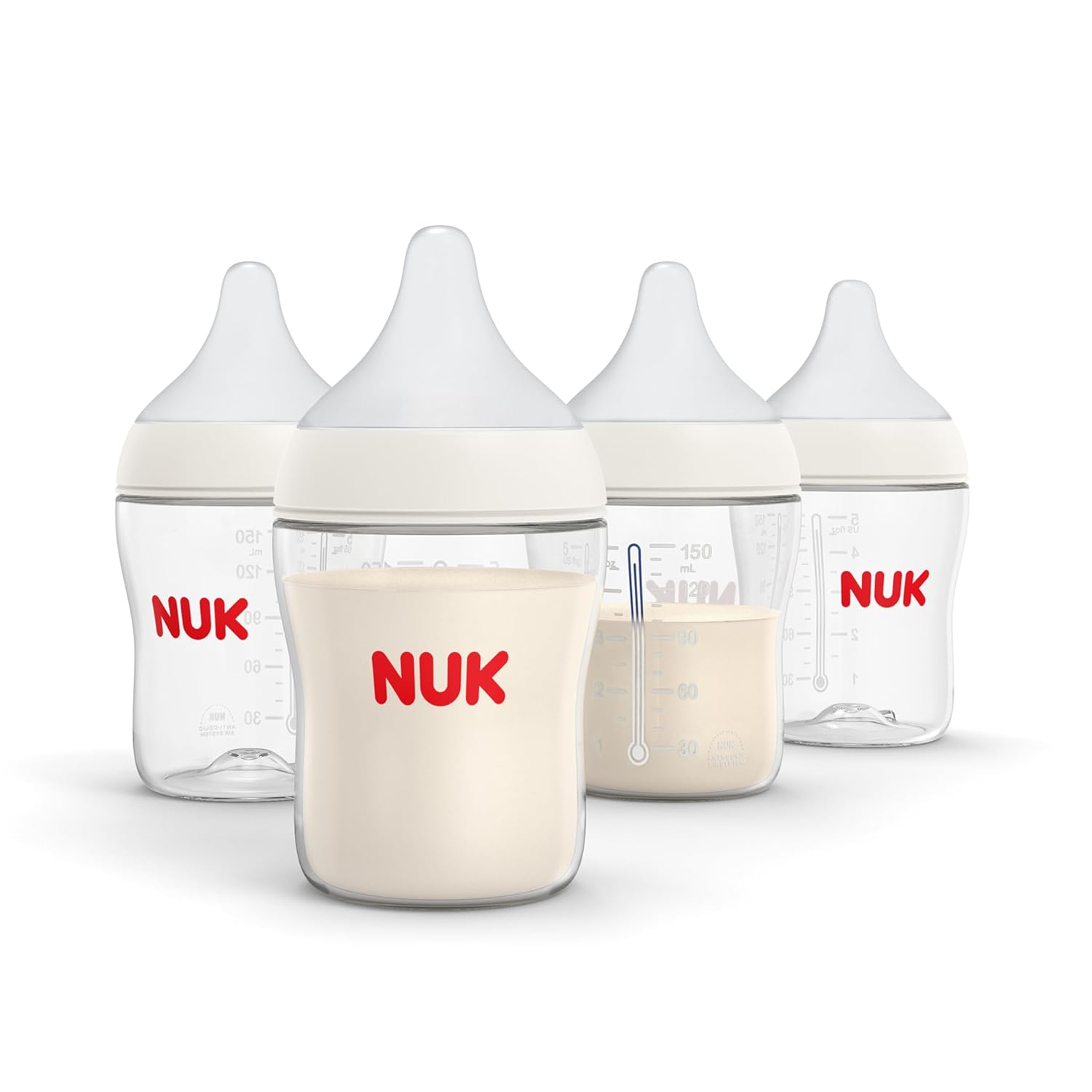
NUK Perfect Match Natural Transition
Best for: Babies transitioning from breast to bottle
- 5 oz
- 4-pack
- natural transition nipple design
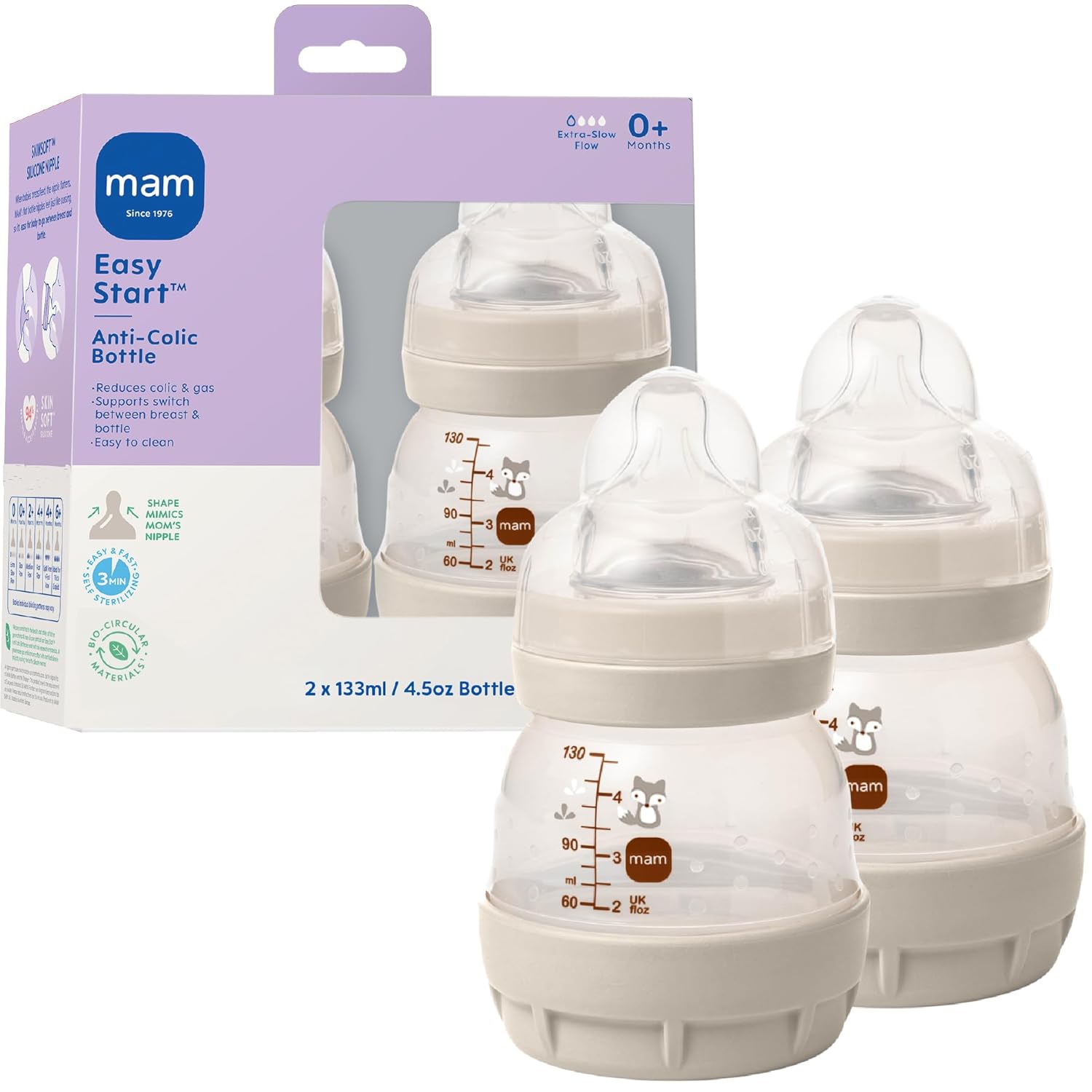
MAM Easy Start Anti-Colic+
Best for: Budget-conscious parents wanting a vented bottle
- 4.5 oz
- 2-pack
- vented anti-colic+ design
- 0+ months

Dr. Brown's Anti-Colic Options+
Best for: Parents prioritizing colic reduction
- 4 oz
- 4-pack
- narrow internal vent system
- Amazon Best Seller
Other awards, each explained in its product section:
- Best glass option: Philips Avent Natural Glass, for parents who prefer glass over plastic.
- Widest neck for cleaning: Evenflo Premium Proflo Venting, wide-neck design.
- Simplest single-piece design: Tommee Tippee Natural Start, breast-like nipple with fewer parts.
- Largest single bottle size: Lansinoh Anti-Colic 8 oz, for babies past the newborn stage.
Quick comparison table
| Model | Best for | Capacity | Pack size | Nipple/vent design | Material | Amazon |
|---|---|---|---|---|---|---|
| NUK Perfect Match Natural Transition | Breast-shaped nipple | 5 oz | 4 | "Natural Transition" nipple shape | Plastic (not stated as glass) | Check Price |
| Philips Avent Natural (Slow Flow) | Everyday slow-flow option | 4 oz | 4 | Slow-flow nipple, BPA-free | Plastic | Check Price |
| Tommee Tippee Natural Start | Fewest parts | Not stated (set) | Set | Breast-like nipple, 0m+ | Not stated | Check Price |
| Lansinoh Anti-Colic 8 oz | Larger single bottle | 8 oz | 3 | Anti-colic vent | Not stated | Check Price |
| MAM Easy Start Anti-Colic+ | Best value anti-colic | 4.5 oz | 2 | Vented anti-colic+, 0+ months | Not stated | Check Price |
| Dr. Brown's Anti-Colic Options+ | Most thorough venting | 4 oz | 4 | Narrow internal vent system | Not stated | Check Price |
| Evenflo Premium Proflo Venting | Widest neck | 9 oz | 6 | Balance Plus venting, wide neck | Not stated | Check Price |
| Philips Avent Natural Glass | Glass option | 4 oz | 4 | Slow-flow nipple, BPA-free | Glass | Check Price |
Notes:
- Capacity, pack size and vent/nipple design are taken directly from each Amazon listing title and bullet points. Where a listing did not state material (plastic vs. another material), we wrote "not stated" rather than assume plastic.
- We did not list star ratings or review counts; these change daily and were excluded on purpose.
- We did not show exact scraped prices, since Amazon prices change frequently. Use the "Check Price" links for current pricing.
How we researched these baby bottles
We searched Amazon for "baby bottles for breastfed babies" on November 4, 2026, and reviewed listings that stated a clear capacity, pack size and either a nipple-shape claim or an anti-colic/venting system. From that search we selected eight bottles that were each distinct in design (different nipple approach, vent system, material or pack format) rather than near-duplicates of one another. We used only the specifications, feature claims and bullet points published on the Amazon listing itself. We did not test these bottles with a baby, did not measure nipple flow rate, and did not independently verify every manufacturer claim (such as "reduces colic") beyond what each listing states.
NUK Perfect Match Natural Transition: breast-shaped nipple
Real-world scenario: A parent who breastfeeds but needs occasional bottle feeds (for example, a return to work) and wants a nipple shape the listing specifically markets as closer to the breast.
Compared with alternatives: The Tommee Tippee also markets a "breast-like" nipple, but NUK's listing calls out "Natural Transition" by name as the core feature, while Tommee Tippee's listing emphasizes a single-piece, simpler design.
What we like:
- Nipple shape marketed specifically for the breast-to-bottle transition
- 4-pack gives spares without a second purchase
- 5 oz capacity suits early-stage feeding volumes
Keep in mind:
- The listing does not state nipple material
- No published flow-rate number to compare against other bottles
- Only one capacity size shown in this listing
Philips Avent Natural: everyday slow-flow option
Philips Avent's listing describes this bottle as "Natural," "Slow Flow," and "BPA-Free," sold in a 4 oz, 4-pack format. The listing markets the nipple as designed for a natural latch, though it does not state the exact flow rate in mL/min.
Real-world scenario: A parent wanting a widely available, mid-priced bottle for daily use without specialized anti-colic hardware.
Compared with alternatives: Unlike the Dr. Brown's and MAM options, this Philips Avent listing does not mention a vent system, so parents specifically seeking anti-colic features may prefer those instead. Philips does offer a glass version of the same design (see below).
What we like:
- Slow-flow nipple stated directly on the listing
- BPA-free material confirmed
- 4-pack format
Keep in mind:
- No anti-colic vent system mentioned in this listing
- Exact flow rate in mL/min not published
Tommee Tippee Natural Start: simplest single-piece design
Tommee Tippee's listing markets this bottle around a "breast-like" nipple and is rated for 0 months and up. The listing is for a bottle set rather than a single stated capacity.
Real-world scenario: A parent who wants to minimize the number of parts to wash and reassemble daily, prioritizing a simple design over an internal venting system.
Compared with alternatives: Where Dr. Brown's and Evenflo add internal venting hardware (more pieces to clean), Tommee Tippee's listing emphasizes a simpler build with a breast-like nipple as the main feature.
What we like:
- Marketed specifically around a breast-like nipple shape
- Rated for 0+ months per the listing
- Simpler design than multi-part anti-colic systems, per the listing's description
Keep in mind:
- Listing does not state individual bottle capacity clearly (sold as a set)
- No anti-colic vent system stated
- Material not specified on the listing
Lansinoh Anti-Colic 8 oz: larger single bottle
Lansinoh's listing describes an anti-colic vent system in an 8 oz bottle, sold as a 3-count pack. This is the largest single capacity among the eight bottles compared here.
Real-world scenario: A parent whose baby has moved past the newborn stage and needs a larger capacity per feed, while still wanting an anti-colic design.
Compared with alternatives: At 8 oz, this is double the capacity of the MAM and matches Dr. Brown's and Philips Avent's smaller 4 oz bottles two-to-one; parents with younger, smaller-volume feeders may prefer the 4-4.5 oz options instead.
What we like:
- Anti-colic vent system stated on the listing
- 8 oz capacity, the largest single size compared here
- 3-count pack
Keep in mind:
- Material not stated on the listing
- Larger capacity may not suit newborns who feed in smaller volumes
- No stated nipple flow rate
MAM Easy Start Anti-Colic+: best value anti-colic
MAM's listing describes a vented "Anti-Colic+" design rated for 0+ months, sold in a 2-pack at 4.5 oz each. Among the anti-colic bottles compared here, this listing had the lowest price per bottle.
Real-world scenario: A parent who wants a vented, anti-colic bottle but is working with a tighter budget, or wants to trial the design before buying a larger pack.
Compared with alternatives: Dr. Brown's and Evenflo also offer venting systems, but in 4-packs and 6-packs respectively; the MAM 2-pack is a smaller commitment if a parent is unsure whether their baby will take to it.
What we like:
- Vented anti-colic+ design stated on the listing
- Lowest per-bottle cost among the anti-colic options compared
- 0+ months rating stated directly
Keep in mind:
- Smaller 2-pack means fewer spares on hand
- Material not stated on the listing
- Smallest capacity (4.5 oz) among the anti-colic bottles here
Dr. Brown's Anti-Colic Options+: most thorough venting
Dr. Brown's listing describes a narrow internal vent system in a 4 oz, 4-pack format, and the listing carries an Amazon Best Seller badge in this category at the time we checked. Dr. Brown's internal vent is built from additional internal parts compared with the simpler vent designs on MAM or Evenflo's listings.
Real-world scenario: A parent specifically concerned about colic or gas who is willing to clean a few extra internal parts in exchange for what the listing presents as a more complete venting system.
Compared with alternatives: Where MAM's vent sits as a single valve, Dr. Brown's listing describes an internal tube/vent system with more individual pieces — more parts to clean, but marketed as more thorough air-flow management.
What we like:
- Internal vent system described as the main feature on the listing
- Sold as a 4-pack
- Carried an Amazon Best Seller badge in this category when checked
Keep in mind:
- More internal parts likely mean more pieces to wash and reassemble (the listing's own diagram shows multiple components)
- Material not stated
- Best Seller badges can change; this is accurate only as of our check date
Evenflo Premium Proflo Venting: widest neck
Evenflo's listing describes a "Balance Plus" venting system in a wide-neck bottle, 9 oz capacity, sold as a 6-pack. The listing states the design is meant to help reduce colic. The wide-neck shape is marketed as easier to fill and clean than narrow-neck bottles.
Real-world scenario: A parent who bottle-feeds frequently and wants a larger pack on hand, with a wide opening for easier scooping of formula or faster cleaning.
Compared with alternatives: At 9 oz, this is the largest capacity in our comparison, and the 6-pack is also the largest pack size, useful for parents doing many bottle feeds per day rather than occasional ones.
What we like:
- Wide-neck design stated on the listing, easier to fill/clean per the description
- Largest capacity (9 oz) compared here
- 6-pack is the largest pack size in this group
Keep in mind:
- Material not stated on the listing
- 9 oz may be more capacity than a newborn needs per feed
- No nipple flow rate published
Philips Avent Natural Glass: glass option
This is Philips Avent's glass version of its Natural, Slow Flow, BPA-free bottle, also sold as a 4 oz, 4-pack. The specs otherwise match the plastic Philips Avent listing above, with glass as the stated material difference.
Real-world scenario: A parent who specifically wants to avoid plastic bottles and is willing to handle the added weight and breakage risk of glass.
Compared with alternatives: This is the only bottle in our comparison where the listing explicitly states glass as the material; every other listing either states plastic or does not specify.
What we like:
- Glass material explicitly stated, the only one in this comparison
- Same slow-flow, BPA-free nipple design as the plastic Philips Avent version
- 4-pack format
Keep in mind:
- Glass is heavier and can break if dropped, which the listing does not address directly
- No anti-colic vent system mentioned
- Typically priced higher than the plastic version of the same design
How to choose the best baby bottle for breastfed babies
Nipple shape and flow
Some listings specifically market a "breast-like" or "natural transition" nipple shape, aimed at reducing bottle refusal. Not every listing states an exact flow rate in mL/min, so flow speed is often described only in general terms ("slow flow") rather than a precise number. If a listing doesn't state flow rate, treat it as unconfirmed rather than assuming "newborn slow."
Anti-colic and venting systems
Several bottles in this comparison (MAM, Dr. Brown's, Evenflo, Lansinoh) include a stated anti-colic or venting design, meant to reduce the air a baby swallows during feeding. These systems add parts to clean. Bottles without a stated vent system (Philips Avent, NUK, Tommee Tippee in this comparison) are typically simpler to clean but don't make the same anti-colic claim.
Material: plastic vs. glass
Only one bottle here (Philips Avent Natural Glass) explicitly states glass as its material. The rest either state plastic or don't specify. Glass avoids some parents' concerns about plastic but adds weight and breakage risk that none of the listings address directly.
Capacity and pack size
Capacities in this comparison ranged from 4 oz to 9 oz, and pack sizes from 2 to 6. A smaller capacity (4-5 oz) generally suits newborn feeding volumes, while a larger capacity (8-9 oz) suits an older baby eating more per feed. A larger pack size reduces how often you need to reorder but costs more upfront.
Verifying claims before you buy
Terms like "reduces colic" or "closer to the breast" are manufacturer marketing claims stated on the listing, not independently verified outcomes. If a specific health concern (reflux, colic, poor weight gain) is driving your bottle choice, a pediatrician's guidance should take priority over any single bottle's marketing claim.
Frequently asked questions
Can I use any bottle for a breastfed baby, or does it need to be marketed specifically for breastfeeding?
Any bottle can technically work. Bottles marketed "for breastfed babies" simply claim a nipple shape intended to reduce bottle refusal, but acceptance varies by baby, and a bottle not specifically marketed this way may still work fine.
Do anti-colic bottles actually reduce colic?
The listings in this comparison state that their vent systems are designed to reduce air intake, which manufacturers link to colic and gas. We did not independently verify this claim, and colic has multiple possible causes beyond air swallowed during feeding.
Why don't you list star ratings for these bottles?
Star ratings and review counts change daily and can be manipulated or become outdated quickly, so we chose not to publish them. We recommend checking current ratings directly on the Amazon listing before buying.
What if my baby refuses every bottle I try?
This is common and not unique to any one brand or nipple shape. Trying a different nipple shape, having someone other than the breastfeeding parent offer the bottle, and offering it before the baby is overly hungry are commonly suggested approaches; a pediatrician or lactation consultant can advise further if refusal persists.
Is glass or plastic better for a baby bottle?
Neither material is stated as objectively "better" by the listings we reviewed. Glass avoids some plastic concerns but is heavier and can break. Plastic is lighter and more common but wasn't specified as BPA-free on every listing we checked — always confirm BPA-free status directly on the listing.
How many bottles do I actually need?
This depends on how often you bottle-feed. The pack sizes in this comparison range from 2 to 6, which gives a sense of how manufacturers themselves bundle these products — a 2-pack suggests occasional use, while a 6-pack suggests manufacturers expect more frequent use.
Sources
- All product specifications, pack sizes and feature claims: Amazon product listings (accessed November 4, 2026)
Verified: November 4, 2026
I enjoy researching everyday products, comparing features, and finding options that offer real value. Here at 5 BESTPRO, I share practical buying guides and helpful product insights to make choosing the right product a little easier. My goal is to help you shop with confidence and spend your money wisely. Read our editorial policy.
This page is general information, not medical advice. Ask a doctor or physical therapist which product suits you.