
Home › Electronics › Chargers
Chargers · Best of
Best Portable Power Bank for Phones (2026): 8 Chargers Compared

Best portable power bank for phones, compared on capacity, output ports and charging speed, based on current Amazon listings.
The best portable power bank for phones usually comes down to a trade-off between capacity and size: more mAh means more charges, but also more weight to carry. We compared eight power banks on capacity, charging speed, port count and build, using current Amazon listings. Three stand out: the INIU 10000mAh 45W for the best balance of fast charging in a small size, the Anker 20,000mAh Travel Essential for its built-in cable and trusted brand reliability, and the 60000mAh 5-Device power bank for the highest capacity in this comparison. We have not tested these power banks ourselves.
Table of contents
- Our top picks
- Quick comparison table
- How we researched these power banks
- INIU 10000mAh 45W: best size-to-speed balance
- Anker 20,000mAh Travel Essential: built-in cable convenience
- Miady 2-Pack Slim 10000mAh: best value multi-pack
- 60000mAh 5-Device: highest capacity
- Jackery Explorer 300: only AC-outlet option
- INIU Smallest 20000mAh: smallest for its capacity
- Anker 10,000mAh PowerIQ: compact Anker option
- BLAVOR Solar 20000mAh: only off-grid charging option
- How to choose the best portable power bank for phones
- Frequently asked questions
- Sources
Our top picks
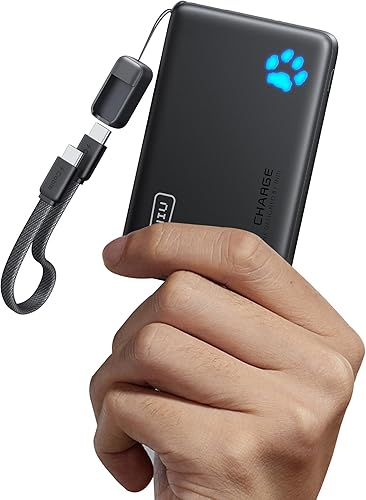
INIU 10000mAh 45W Fast Charging
Best for: Everyday carry, fast top-ups
- 10,000mAh
- 45W fast charging
- Amazon's Choice

Anker 20,000mAh Travel Essential
Best for: Travelers who forget cables
- 20,000mAh
- built-in USB-C cable

60000mAh 5-Device Power Bank
Best for: Multi-device households, long trips
- 60,000mAh
- 22.5W fast charge
- charges up to 5 devices
Other awards, each explained in its product section:
- Best value multi-pack: Miady 2-Pack Slim 10000mAh, two power banks for one purchase.
- Smallest for its capacity: INIU Smallest 20000mAh, higher capacity in a compact build.
- Best compact Anker option: Anker 10,000mAh PowerIQ, a smaller alternative to the 20,000mAh Anker.
- Only off-grid charging option: BLAVOR Solar 20000mAh, built-in solar panel and wireless charging.
- Only AC-outlet option: Jackery Explorer 300 Portable Power Station, for laptops and larger devices.
Quick comparison table
| Model | Best for | Capacity | Charging speed | Ports/features | Amazon |
|---|---|---|---|---|---|
| INIU 10000mAh 45W | Size-to-speed balance | 10,000 mAh | 45W fast charging | Amazon's Choice badge | Check Price |
| Miady 2-Pack Slim | Value multi-pack | 10,000 mAh each | Not stated | Sold as 2 units | Check Price |
| 60000mAh 5-Device | Highest capacity | 60,000 mAh | 22.5W fast charge | Charges up to 5 devices per listing | Check Price |
| Jackery Explorer 300 | AC-outlet charging | 292 Wh | Not stated | Portable power station, not a pocket bank; Amazon Best Seller | Check Price |
| Anker 20,000mAh Travel Essential | Built-in cable | 20,000 mAh | Not stated | Built-in USB-C cable | Check Price |
| INIU Smallest 20000mAh | Smallest for its capacity | 20,000 mAh | 22.5W fast charging | Marketed as smallest in its capacity class | Check Price |
| Anker 10,000mAh PowerIQ | Compact Anker option | 10,000 mAh | PowerIQ (speed not stated in W) | USB-C, smaller than the 20,000mAh Anker | Check Price |
| BLAVOR Solar 20000mAh | Off-grid charging | 20,000 mAh | Not stated | Built-in solar panel; wireless charging for phones and Apple Watch | Check Price |
Notes:
- Capacity, charging speed (watts) and feature claims are taken directly from each Amazon listing title. Where a listing did not state wattage, we wrote "not stated" rather than estimate.
- The Jackery is a portable power station (AC outlet, larger device charging) rather than a pocket-sized power bank; we included it because its listing appeared alongside power banks in search results and it is relevant for buyers who need to charge laptops, not just phones.
- We did not list star ratings or review counts; these change daily and were excluded on purpose.
- We did not show exact scraped prices. Use the "Check Price" links for current pricing.
How we researched these power banks
We searched Amazon for "portable power banks" on November 4, 2026, and reviewed listings that stated a clear capacity (mAh or Wh) and at least one other distinguishing feature (charging speed, built-in cable, solar panel, or similar). From that search we selected eight products that were each distinct from one another — different capacities, brands or features — rather than near-duplicates. We used only the specifications and feature claims published on each Amazon listing. We did not test charging speed, did not verify battery cycle life, and did not independently confirm "fast charging" wattage claims beyond what each listing states.
INIU 10000mAh 45W: best size-to-speed balance
Real-world scenario: A commuter or traveler who wants one or two full phone charges from a bank small enough to carry daily, with fast-charging speed for quick top-ups.
Compared with alternatives: At the same 10,000mAh capacity, the Anker PowerIQ option doesn't state a wattage figure, so the INIU's stated 45W gives it a clearer speed claim for comparison.
What we like:
- 45W fast charging stated directly on the listing
- Marketed specifically as a smaller, travel-oriented size
- Amazon's Choice badge at the time we checked
Keep in mind:
- No stated weight or exact dimensions
- 10,000mAh means recharging after roughly one to two full phone charges, depending on phone battery size
- Amazon's Choice badges can change over time; accurate only as of our check date
Anker 20,000mAh Travel Essential: built-in cable convenience
Anker's listing describes a built-in USB-C cable as the headline feature of this 20,000mAh power bank, aimed at travelers who don't want to carry a separate charging cable. Anker is a widely recognized brand in this category.
Real-world scenario: A frequent traveler who has forgotten charging cables before and wants one less thing to pack or lose.
Compared with alternatives: The BLAVOR solar bank is also 20,000mAh but adds solar charging instead of a built-in cable; the INIU Smallest 20000mAh focuses on compact size at the same capacity instead.
What we like:
- Built-in USB-C cable removes the need to pack one separately
- 20,000mAh capacity, enough for multiple phone charges per the stated figure
- Recognized brand with a long track record in portable chargers
Keep in mind:
- Charging wattage not stated on this specific listing
- A built-in cable means you're limited to that connector unless the bank also has a separate port (not specified in the listing)
- Heavier than the 10,000mAh options in this comparison, given the larger capacity
Miady 2-Pack Slim 10000mAh: best value multi-pack
Miady's listing sells two slim 10,000mAh power banks together as a set, positioned as a travel battery pack. This is the only multi-pack option in our comparison.
Real-world scenario: A household wanting to equip two people (or keep one as a backup) without buying two separate listings, or a parent wanting one for themselves and one for a teenager.
Compared with alternatives: Every other power bank here is sold as a single unit; the Miady's 2-pack format means a lower cost per unit if you need more than one, even though the per-bank capacity (10,000mAh) matches the INIU.
What we like:
- Two power banks included in one purchase
- Slim form factor stated on the listing
- Matches the INIU's 10,000mAh capacity, giving a similar charge count per bank
Keep in mind:
- Charging wattage not stated on the listing
- Slim design may trade some durability for portability (not confirmed either way by the listing)
- Only useful as a value pick if you actually need two units
60000mAh 5-Device: highest capacity
This listing describes a 60,000mAh power bank with 22.5W fast charging, marketed as able to charge up to 5 devices. It is the highest-capacity single unit in our comparison by a wide margin.
Real-world scenario: A group trip, camping outing, or long flight where multiple people or devices need charging without access to an outlet for an extended period.
Compared with alternatives: At six times the capacity of the 10,000mAh options, this bank trades portability for charge count; the Jackery offers even more total energy (292Wh, roughly equivalent to over 70,000mAh) but through AC outlets rather than USB ports.
What we like:
- 60,000mAh is the highest capacity among the pocket-style power banks compared here
- 22.5W fast charging stated on the listing
- Marketed to charge up to 5 devices, useful for groups
Keep in mind:
- Higher capacity means significantly more weight and bulk than the 10,000-20,000mAh options
- "Charges up to 5 devices" likely refers to multiple ports or sequential charges, not simultaneous full-speed charging for all 5 — the listing doesn't clarify
- Longer to fully recharge the bank itself, given the much larger capacity
Jackery Explorer 300: only AC-outlet option
Unlike the other seven products compared here, the Jackery Explorer 300 is a portable power station rated in Wh (watt-hours) rather than mAh, and it includes an AC outlet rather than only USB ports. Its listing carried an Amazon Best Seller badge in its category at the time we checked.
Real-world scenario: Charging a laptop, camera equipment, or small appliance during a power outage or outdoor trip, not just topping up a phone.
Compared with alternatives: None of the other seven power banks in this comparison offer an AC outlet; if your only need is phone charging, a standard USB power bank is lighter and cheaper. The Jackery is relevant here specifically for buyers who also need to charge non-USB devices.
What we like:
- AC outlet, a feature none of the other products here offer
- 292Wh capacity, among the largest total energy in this comparison
- Carried an Amazon Best Seller badge when checked
Keep in mind:
- Significantly larger, heavier and more expensive than a standard phone power bank
- Charging speed not stated on the listing
- Overkill if phone charging is your only need
INIU Smallest 20000mAh: smallest for its capacity
INIU's listing markets this as the smallest power bank in its 20,000mAh capacity class, with 22.5W fast charging. This gives it double the capacity of the first INIU bank in this comparison while still being marketed around compact size.
Real-world scenario: A traveler who wants more than one full phone charge but still prioritizes a compact size over the absolute lowest weight.
Compared with alternatives: Compared with the Anker 20,000mAh (built-in cable) and BLAVOR 20,000mAh (solar), this INIU's distinguishing claim is specifically its small size at that capacity, rather than an added feature like a cable or solar panel.
What we like:
- 22.5W fast charging stated on the listing
- 20,000mAh capacity, double the smaller INIU model
- Marketed specifically as the smallest in its capacity class
Keep in mind:
- Weight and exact dimensions not stated on the listing, so "smallest" can't be independently verified against the other 20,000mAh options here
- No built-in cable or solar feature, unlike two of the other 20,000mAh options compared
Anker 10,000mAh PowerIQ: compact Anker option
This is Anker's smaller offering in our comparison, at 10,000mAh with their PowerIQ charging technology and a USB-C port. The listing does not state an exact wattage figure for PowerIQ on this model.
Real-world scenario: Someone who trusts the Anker brand but wants a smaller, lighter option than the 20,000mAh Travel Essential also compared here.
Compared with alternatives: Matches the INIU and Miady on capacity (10,000mAh), but doesn't state a wattage figure the way the INIU does (45W), making a direct speed comparison difficult from the listings alone.
What we like:
- Recognized Anker brand and PowerIQ charging technology
- USB-C port
- Smaller, lighter option within the Anker lineup compared here
Keep in mind:
- No stated wattage figure, unlike the INIU 10000mAh in this comparison
- No built-in cable, unlike Anker's own 20,000mAh Travel Essential model
BLAVOR Solar 20000mAh: only off-grid charging option
BLAVOR's listing describes a built-in solar panel and wireless charging compatible with phones and Apple Watch, at 20,000mAh capacity. This is the only solar-equipped and only wireless-charging-capable bank in our comparison.
Real-world scenario: Camping, hiking, or other outdoor situations where mains power isn't available for extended periods, where trickle solar charging could help maintain charge.
Compared with alternatives: No other power bank in this comparison offers solar charging or wireless charging; the trade-off is that solar panels on compact power banks typically charge slowly and work best as a backup rather than a primary charging method (the listing does not state a solar charging time).
What we like:
- Only solar-charging option in this comparison
- Wireless charging stated as compatible with phones and Apple Watch
- 20,000mAh capacity, matching the other mid-capacity options here
Keep in mind:
- Solar charging time not stated on the listing; solar panels on compact devices are typically slow and supplementary rather than a primary charge source
- Wireless charging is generally slower than wired charging, though the listing doesn't provide a wattage figure for it
- Likely bulkier than non-solar banks at the same capacity, due to the panel, though exact dimensions aren't stated
How to choose the best portable power bank for phones
Capacity vs. portability
Capacities in this comparison ranged from 10,000mAh to 60,000mAh (plus the Jackery's 292Wh power station). A 10,000mAh bank typically gives one to two full phone charges and is easiest to carry daily. A 20,000mAh bank roughly doubles that. Above 20,000mAh, weight and bulk increase quickly, so reserve higher capacities for trips rather than daily carry.
Charging speed (wattage)
Not every listing states a wattage figure. Where stated, speeds in this comparison ranged from 22.5W to 45W. A higher wattage number generally means faster charging, but your phone's own maximum charging speed also limits how fast it will actually charge — a 45W bank won't charge a phone that maxes out at 20W any faster than a 20W-capable bank would.
Built-in cable vs. separate cable
Two products here (Anker 20,000mAh) include a built-in cable, which is convenient but limits you to that connector type unless the bank has additional ports. Banks without a built-in cable are more flexible (any compatible cable works) but require you to remember to pack one.
Special features: solar and wireless charging
Only one bank in this comparison (BLAVOR) offers solar charging and wireless charging. These are genuinely useful for off-grid situations or avoiding cable clutter, but typically charge slower than a direct wired connection — useful as a backup feature, not necessarily your primary charging method.
When you need more than a phone charger
If you need to charge a laptop or run small appliances, a standard USB power bank (even a high-capacity one) usually isn't designed for that. The Jackery Explorer 300 in this comparison is a portable power station with an AC outlet built for that purpose, at a higher price and larger size than a pocket power bank.
Frequently asked questions
Can I bring a portable power bank on a flight?
Most airlines allow power banks in carry-on luggage with capacity restrictions (commonly up to 100Wh, roughly 27,000mAh at 3.7V, without airline approval, and some permit more with approval). Check your specific airline's policy and the bank's Wh rating before flying, since mAh alone doesn't determine airline compliance — Wh does.
How many times can a power bank charge my phone?
This depends on both the bank's capacity and your phone's battery size, plus charging losses (not all capacity transfers to your phone). As a rough guide, a bank with roughly double your phone's battery capacity in mAh will typically give close to two full charges, accounting for some energy loss.
Does fast charging work with any cable?
No — fast charging requires both a cable rated for the higher wattage and a phone that supports fast charging at that speed. A standard cable can bottleneck a fast-charging-capable power bank.
Why don't you list star ratings for these power banks?
Star ratings and review counts change daily and can become outdated or be manipulated, so we chose not to publish them. Check current ratings directly on the Amazon listing before buying.
Is a higher mAh number always better?
Not necessarily. Higher capacity means more charges but also more weight, longer recharge time for the bank itself, and sometimes airline restrictions. Match capacity to how you'll actually use it — daily commuting favors a smaller bank, while multi-day trips favor higher capacity.
What's the difference between a power bank and a portable power station?
A power bank (like the INIU, Anker, Miady, or BLAVOR options here) charges small devices via USB and is rated in mAh. A portable power station (like the Jackery here) is larger, includes an AC outlet, and is rated in Wh — designed for laptops, small appliances, or longer power outages rather than just phones.
Sources
- All product specifications and feature claims: Amazon product listings (accessed November 4, 2026)
Verified: 4 Nov 2026
I enjoy researching everyday products, comparing features, and finding options that offer real value. Here at 5 BESTPRO, I share practical buying guides and helpful product insights to make choosing the right product a little easier. My goal is to help you shop with confidence and spend your money wisely. Read our editorial policy.
This page is general information, not medical advice. Ask a doctor or physical therapist which product suits you.